The state retirement system gave one reason for taking away twenty years of Greg Standard’s service credit: the job description it was shown had “few actual ‘on-call,’ EMS-related activities.” That is a fair description of the document it received. It is not a fair description of Greg Standard’s job — because two other descriptions of his work sat in the county’s own files, and the state was not shown either one.
The county had three.
Greg Standard held more than one position for Seward County, and the county had written descriptions for each of them:
- Emergency Management — Director. The administrative side: planning, grants, drills, the operations center.
- EMS — Advanced EMT. Riding the ambulance.
- Fire — Deputy Fire Chief. Commanding fire scenes.
All three are ordinary Seward County records on the county’s standard form. When the county was finally asked for them, its records office produced all three at once.
He sent only one.
On June 12, 2025, Commissioner Stanton emailed the Emergency Management Director description to the retirement system’s general counsel from todd@americanclassicrenovation.com, a private business address, signed as a Seward County Commissioner.
He did not send the Advanced EMT description. He did not send the Fire Deputy Chief description. The state did not know they existed.
What the description he sent says the job is.
Emergency Management — Director · THE ONE HE SENT
These are the duties, quoted from the county’s form:
- “Responsible for the development, implementation, enforcement and updating of plans and procedures for natural and manmade disasters”
- “Maintains records and grant fund(s) reporting for the Federal Emergency Management Agency (FEMA) and for the Kansas Division of Emergency Management (KDEM)”
- “Prepares annual application for state and local assistance grant funding and manages quarterly reporting”
- “Serves as Administrator on the Local Emergency Planning Committee”
- “Performs and implements monthly tornado siren testing and maintenance”
- “Responsible for emergency generator maintenance”
- “Manages severe weather spotting and training of volunteer spotters”
- “Manages disaster mitigation, response and recovery”
Twenty-three duties in all. Plans, grants, budgets, records, committees, siren tests. Not one of them is answering a call.
The retirement system’s counsel read that document and wrote:
“Because the description had few actual ‘on-call,’ EMS-related activities, it did not appear to be covered under KP&F in my experience.”Laurie McKinnon, KPERS General Counsel, to County Administrator April Warden, August 12, 2025
She was reading it correctly, and Commissioner Stanton chose what she read. He went to the state to have Greg Standard’s fire and EMS service taken off the books, and he handed the state one document out of three — the only one that did not show emergency work. A lawyer working against a July 1 deadline, who believed she was dealing with the county, reached the conclusion that document supported. He got what he asked for. Greg Standard lost twenty years.
What the second description says.
EMS — Advanced EMT · NOT SENT
Same county. Same form. Same man’s work. Its duty list begins:
- “Listens to radio/station and responds to emergency alarms”
- “Drives and/or operate EMS apparatus”
- “Responds to emergency medical calls in accordance with standard practice guidelines and administers basic and minimal advanced levels of emergency medical care”
- “Conducts a patient assessment and attempts to determine the illness or injury sustained by the patient”
- “Performs triage as needed including applying splints, performing CPS, bandaging wounds”
- “Serves as attending AEMT in the ambulance while transporting patient to a medical facility”
- “Decontaminates apparatus, equipment and clothing exposed to potential airborne or blood borne diseases”
And under the requirements for holding the position:
- “Ability to function in life/death situations relying on sight, hearing, smell and touch and have the ability to make critical decisions while maintaining safety of others/self”
- “Understanding of the associated risk of bodily injury/death in performance of duties”
- “Must attain and Kansas AEMT Certification”
The test the state applied was whether the description showed “actual ‘on-call,’ EMS-related activities.” The first duty on this document is responding to emergency alarms. The sixth is riding in the back of the ambulance. The state was never shown it.
“CPS” appears in the county’s original document; we quote it as written.
What the third description says.
Fire — Deputy Fire Chief · NOT SENT
- “Takes personal command of firefighting activities at major fires and/or other catastrophic emergencies that may occur”
- “Responds to fires, and other emergency scenes, from time to time, and makes high-level strategic and tactical decisions as to methods of fighting fires and performing rescues, directs the work of all units in all matters concerning fire mitigation”
- “Plans, organizes, directs and evaluates fire suppression, fire prevention, rescue and emergency medical service programs necessary for the community’s protection”
- “Engages with the Local Emergency Planning Council (LEPC) response plans covering the county area … including Mass Casualty, Haz-Mat, USAR, regional operability, EM System and mutual aid”
On the county’s own scoring of this position, a typical shift involves fire hazards, explosives and electrical hazards continuously; climbing ladders, crawling and kneeling continuously; and carrying 51 to 100 pounds continuously, with anything heavier marked “TANDEM ONLY – NEVER ALONE.” The state was never shown this one either.
He knew the other work existed.
In the same June 12 email that carried the one description, Commissioner Stanton wrote that Greg Standard “was previously rural fire but that was ten or more years ago.”
He knew about the fire service. He sent the one description of the three that did not show it. Whether he knew the other two documents existed, only he can say. What the record shows is that he did not ask the county, and the county is where they were.
The state got all three on August 12 — two months later.
The county was not told any of this was happening. When the County Administrator finally learned of it and sent the retirement system the county’s descriptions, the decision had already been made and Greg Standard had already retired.
“When I received the information from Mr. Stanton, along with the position description you said you’d never seen before, it was my job, then, to review the position, itself… From there, we knew we only had a few weeks to work on Mr. Standard’s retirement as he had applied to retire on July 1, and I went forward with the information I had to ‘correct’ the membership.”Laurie McKinnon, KPERS General Counsel, August 12, 2025
The county administrator told the state she had never seen the document before. In the same message, the state’s own lawyer wrote:
“My error was not contacting you, specifically, to make sure KPERS was moving in the right direction. I take full responsibility for that.”
“I apologize to you all and most of all, Mr. Standard. One note — when Mr. Stanton told me to contact Ms. Conley, I figured at that time it was known in the office what was going on… Again, so much I didn’t know and I’m sorry.”
“We certainly learned a lesson here, too, but in 30 years of working as KPERS’ legal counsel, this has never happened to me.”Laurie McKinnon, KPERS General Counsel, August 12, 2025
The cut was not small. KPERS’s own Deputy Benefits Manager ran the numbers while the matter was still open. With the fire and EMS service counted, Greg Standard’s monthly benefit came to $3,483.03. With only the KPERS service left, “his gross would be only $2,605.73.”
Greg Standard’s pension was cut by $877.30 a month — for the rest of his life, as far as anyone knew, until the county was finally allowed to answer. He had taken a 50 percent joint-and-survivor benefit, so the reduction reached his wife’s share as well.
When the county was at last heard, the retirement system restored every year of the service it had taken. No charges were ever brought against anyone.
Benefit figures: KPERS internal benefit calculation prepared by the Deputy Benefits Manager, July 2025, held in the campaign’s evidence file. The original carries personal information belonging to third parties and is not reproduced here.
The same page, out of two files.
These are the first two pages of the Emergency Management Director description — the description he sent. The words on them are identical, line for line. On the left is the copy that reached Topeka. On the right is the same two pages as they sit in the County’s own file.
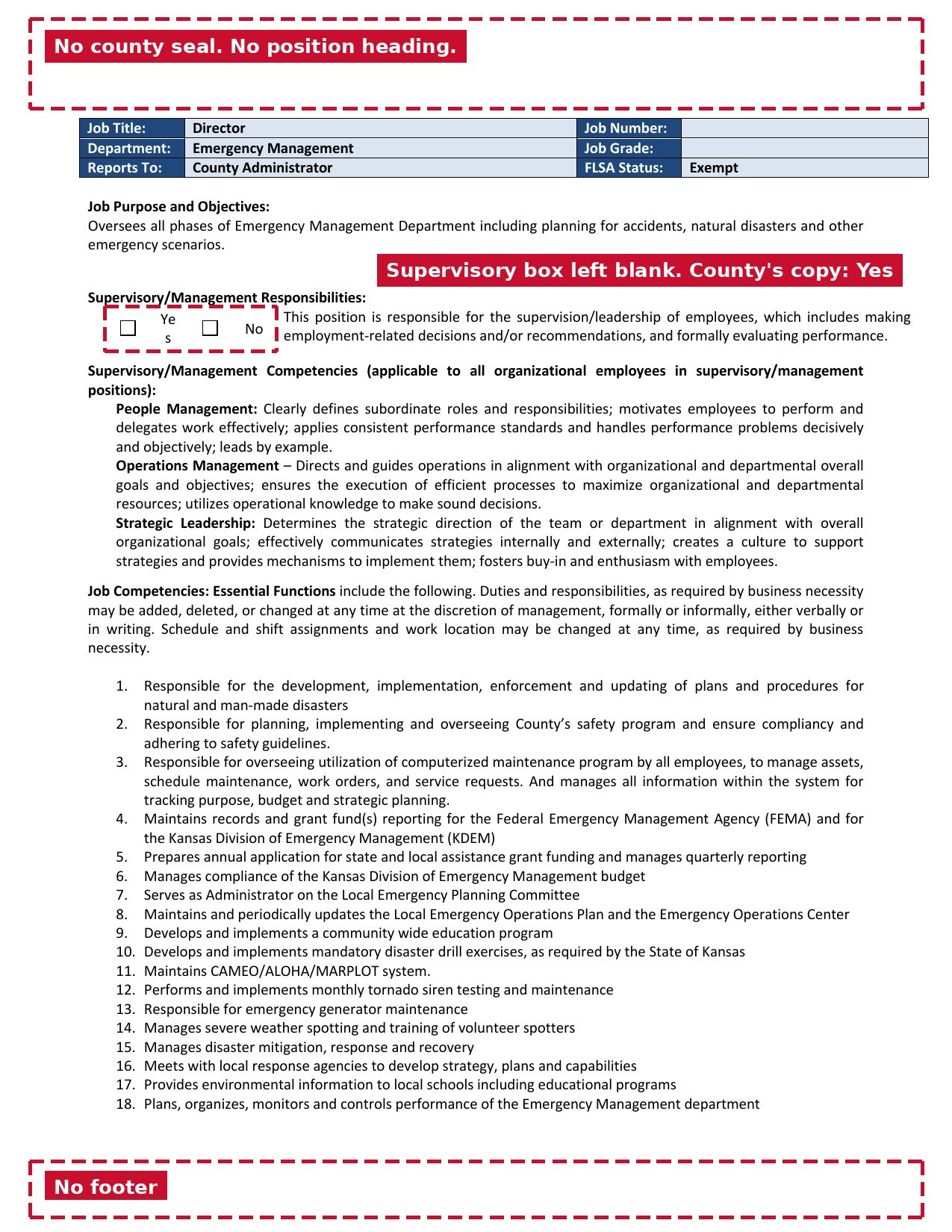
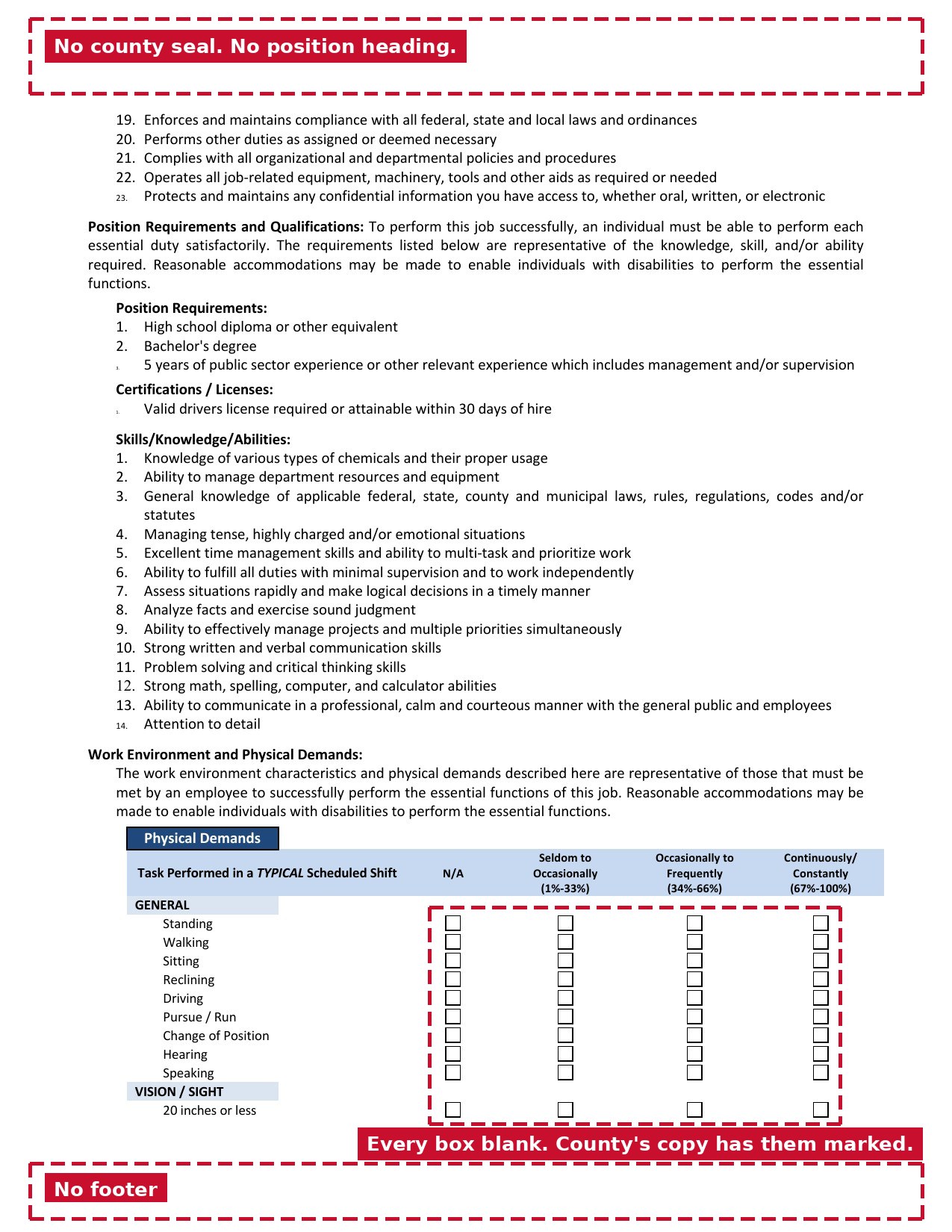
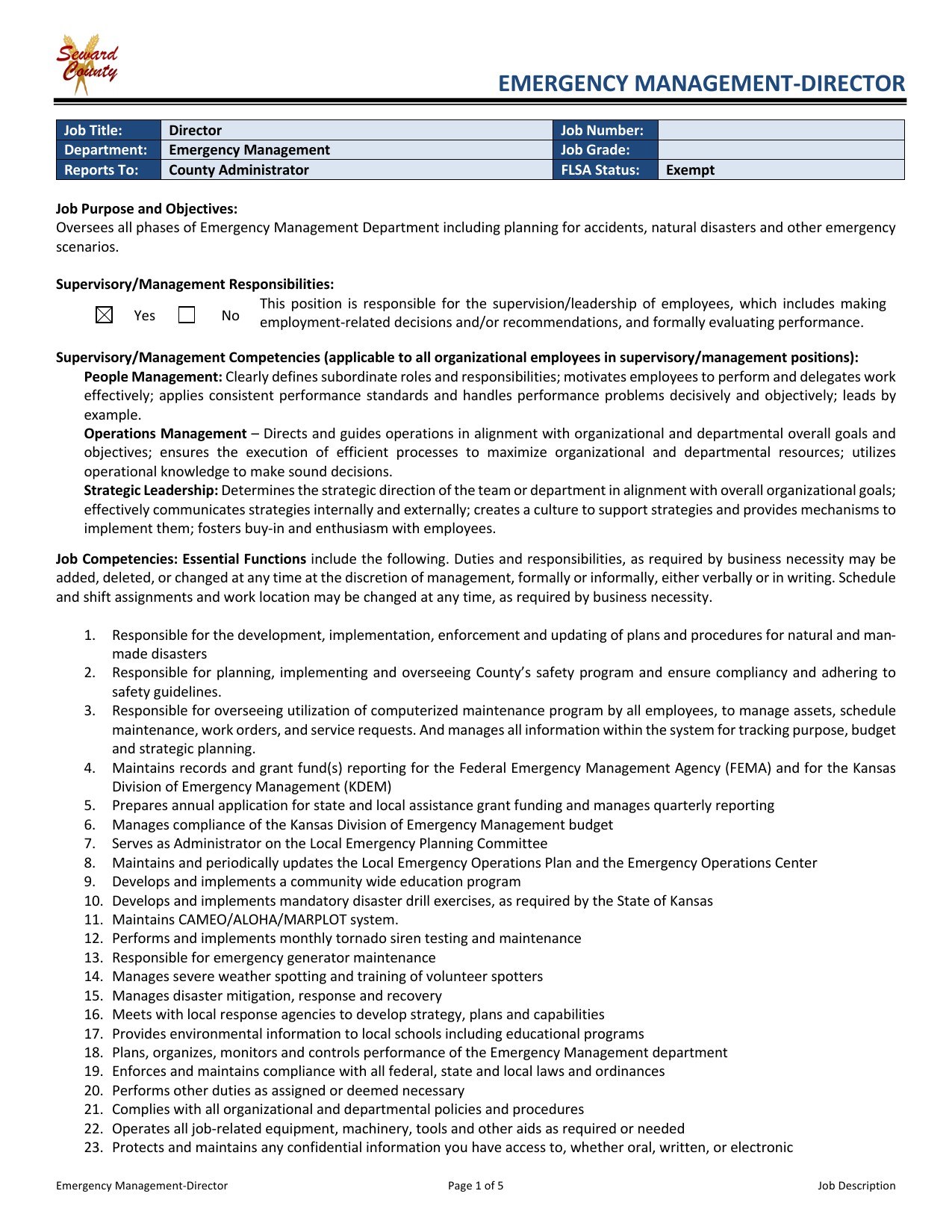
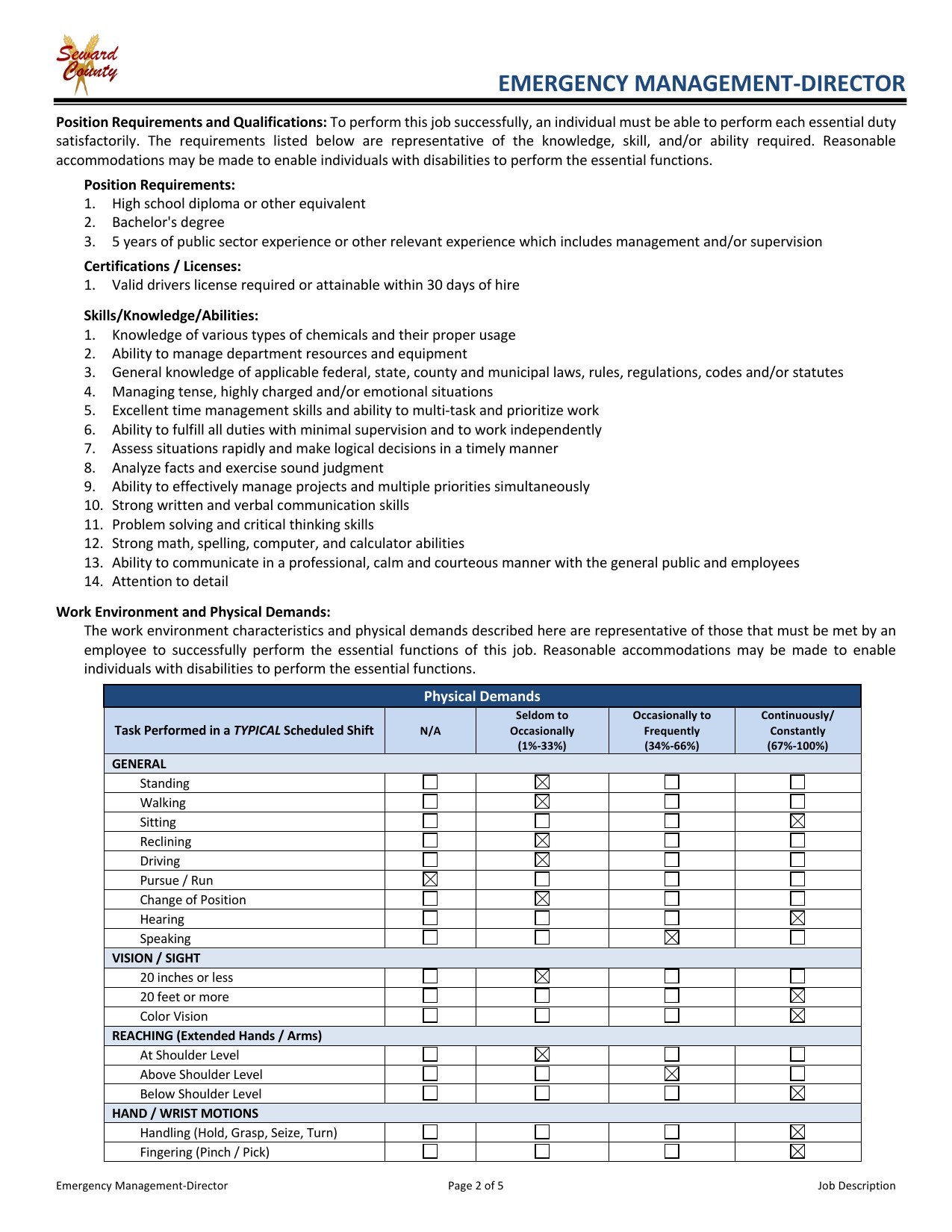
The seal is gone. The heading that names the position is gone. The footer is gone. The box recording that the position supervises employees is no longer marked. The County’s copy runs to five pages; the one he sent runs to seven, because with the header removed the text reflowed onto more of them.
He began with the County’s document. This is what reached the state. Thirteen routes through seven programs were run against the County’s own file. Not one of them removes the seal. The two an ordinary person would actually use come out wrong in opposite directions: pass the file through Google Drive and all 103 marks are still on the page; open it in Apple Pages on a Mac and the checkboxes disappear altogether. Open it in Microsoft Word and save it again and nothing changes at all. Simply forwarding the email would have produced an identical file.
What reached Topeka does something none of them did. All 428 checkboxes are still there, still real form fields and not just printed squares — and every one of them now carries an instruction reading “no,” including the 325 that were never marked. The name Word gave each box has been replaced by a single label repeated 428 times. A name written 428 times is a program working through the form one box at a time. Anyone can check it: a Word file is a zip archive, and the values are in plain text inside it.
Full-size images open in a new tab. The forensic examination of both files is set out in the job description file report held with the campaign’s records.
The document the state decided on was not the County’s document. The County’s copy of the Emergency Management Director description is a checklist form with 103 of its 428 boxes marked — including “Yes” for supervising employees — and it carries the County seal, heading and footer. The copy Commissioner Stanton sent had every one of those 103 marks gone and no County letterhead at all. The duty list reads the same in both, and we quote it exactly as written. But a decision that took twenty years of service from a 37-year County employee was made on a stripped copy of one description out of three, sent from a private business email account — and, in his own words to the state, “County Admin was not informed.”
Three descriptions of one man’s work sat in the county’s files. One commissioner, acting alone, from a private email account, sent the state a single one of them — the only one that did not show emergency service. Why did only one of three go to Topeka?
Sources: Seward County job descriptions for Emergency Management — Director, EMS — Advanced EMT, and Fire — Deputy Fire Chief, produced by the Seward County records office; Todd Stanton to KPERS General Counsel, June 12, 2025; April Warden to Laurie McKinnon and Laurie McKinnon’s reply, August 12, 2025. All are in the evidence index.