Greg Standard gave Seward County thirty-seven years. He rode the ambulance as an advanced EMT. He was deputy chief of the fire department. He handled hazardous materials. When the sky turned, he was one of the men out watching it. And he ran the county’s emergency management.
Twenty of those years counted toward the pension Kansas pays its firefighters and police, because that is what the work was.
In June 2025, weeks before he retired, a county commissioner went to the state retirement system about him. Not to the Board. Not to the County Administrator — he told the state she was deliberately not being informed. He wrote from a private business account and signed it as a commissioner.
He sent the state one piece of paper: a job description that did not mention the emergency work.
On July 9 the state moved all twenty years out of the firefighters’ pension. Greg Standard’s first retirement check came up more than a quarter short.
Five weeks later the County gave the retirement system the full picture of his service, and KPERS put every one of those twenty years back. Nothing the commissioner alleged survived.
He was wrong about the job, wrong about the service, and wrong about the man. The only lasting thing he produced was the weeks a thirty-seven-year employee spent not knowing whether the pension he had earned would be there.
Seward County has a Board that meets in public, a County Administrator, a human resources department and a county counselor. Any of them could have answered the question in an afternoon, and the County proved it the moment KPERS finally asked. He used none of them. He took four separate steps instead, and every one had the same effect.
He wrote from an account his county could not see.
He has a Seward County email address and he uses it — on October 14, 2025 he used it to tell the County Administrator that her account of his behaviour had been “shared with counsel for action.” Not this. Every message to the retirement system went out from todd@americanclassicrenovation.com, a private business address, signed “Todd Stanton, Seward County Commissioner District 1.”
He was not hiding from KPERS. He signed those emails with his title so a state agency would treat him as Seward County. He was hiding from Seward County. County business done on the county system is a record any resident can ask to see. None of this was.
He told the state the County Administrator was deliberately not being told.
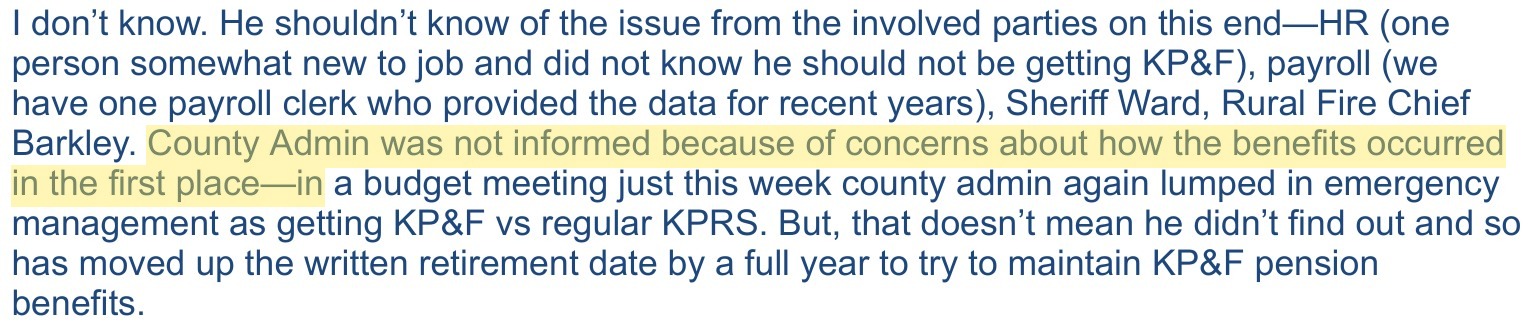
In his own words to the agency, on June 25, 2025: “County Admin was not informed because of concerns about how the benefits occurred in the first place.” April Warden held the complete personnel file — the records that eventually corrected the error. Keeping her out is what allowed a decision to be made on one document.
She was not merely left uninformed. By July 24 she had learned he had also asked Sheriff Gene Ward to file criminal charges against her over the same matter. The Sheriff told him that is not how charges are filed. No charges were ever brought, and once the County was allowed to answer, KPERS restored every one of Greg Standard’s twenty years.
What was left for the state to read?
He sent one description out of three, and it was not the emergency work. The County held three written descriptions covering what Greg Standard actually did: Emergency Management Director, Advanced Emergency Medical Technician, and Fire Deputy Chief. The last two are the ones that describe riding the ambulance and commanding fire scenes. He sent the first, and only the first. He knew the other work existed — in the same June 12, 2025 email he wrote that Standard “was previously rural fire but that was ten or more years ago.” He sent the one description of the three that did not show it.
Then there is the copy itself. That description is a checklist form of 428 boxes, and the County marks the ones that apply — 103 of them. The copy that reached Topeka had all 428 boxes empty, and the county header, footer and seal were gone as well. The narrative wording of the two is identical, word for word; nothing was reworded and we do not claim it was.
KPERS’s counsel wrote that the description showed “few actual ‘on-call,’ EMS-related activities.” We are not claiming the empty boxes are why she wrote that. She said her conclusion rested on the narrative duty language, and that language is the same in both copies; we will not argue past her own account of it. The blank boxes are a separate point, and we keep it separate: what reached Topeka was not the County’s document. What bears on her sentence is the other two descriptions — the Advanced EMT and the Fire Deputy Chief — and she did not see them until August 12, five weeks after the decision. It did not need to look far: the County’s records office produced all three the moment it was asked.
The agency has since said in its own words what one description of three cost it. On August 4, 2025 KPERS’s counsel told the County Administrator that when she made the first determination she “had no idea Greg held down two positions for many years.” Standard held two at once for roughly seventeen years, from 1999 to 2016.
The two files were examined in September 2026. The copy that reached Topeka keeps all 428 of the form’s checkboxes as real form fields — but every mark is gone, and an instruction reading “no” has been written into each one of the 428, including the 325 that were never marked. Every box has also been renamed to one generic label, where the County’s file carries the names Word gives them. The file records being built thirteen minutes before it was emailed. Thirteen routes through seven programs were then run against the County’s own copy, including the two things an ordinary person would actually do: pass the file through Google Drive and all 103 marks are still on the page; open it in Apple Pages on a Mac and the checkboxes disappear altogether. Open it in Microsoft Word and save it again and nothing changes at all — every mark and every field name survives. No route tested produces what was sent. What the examination does not show is anyone retyping the document by hand; a single name written 428 times is a program working through the form, and we say so plainly because it is true. How the copy came to be that way, and whether anyone looked at it before it went, the file cannot say. What is not in question is that the document the state decided on was not the County’s.
He asked to be blind-copied so his own county would not see his name on it.
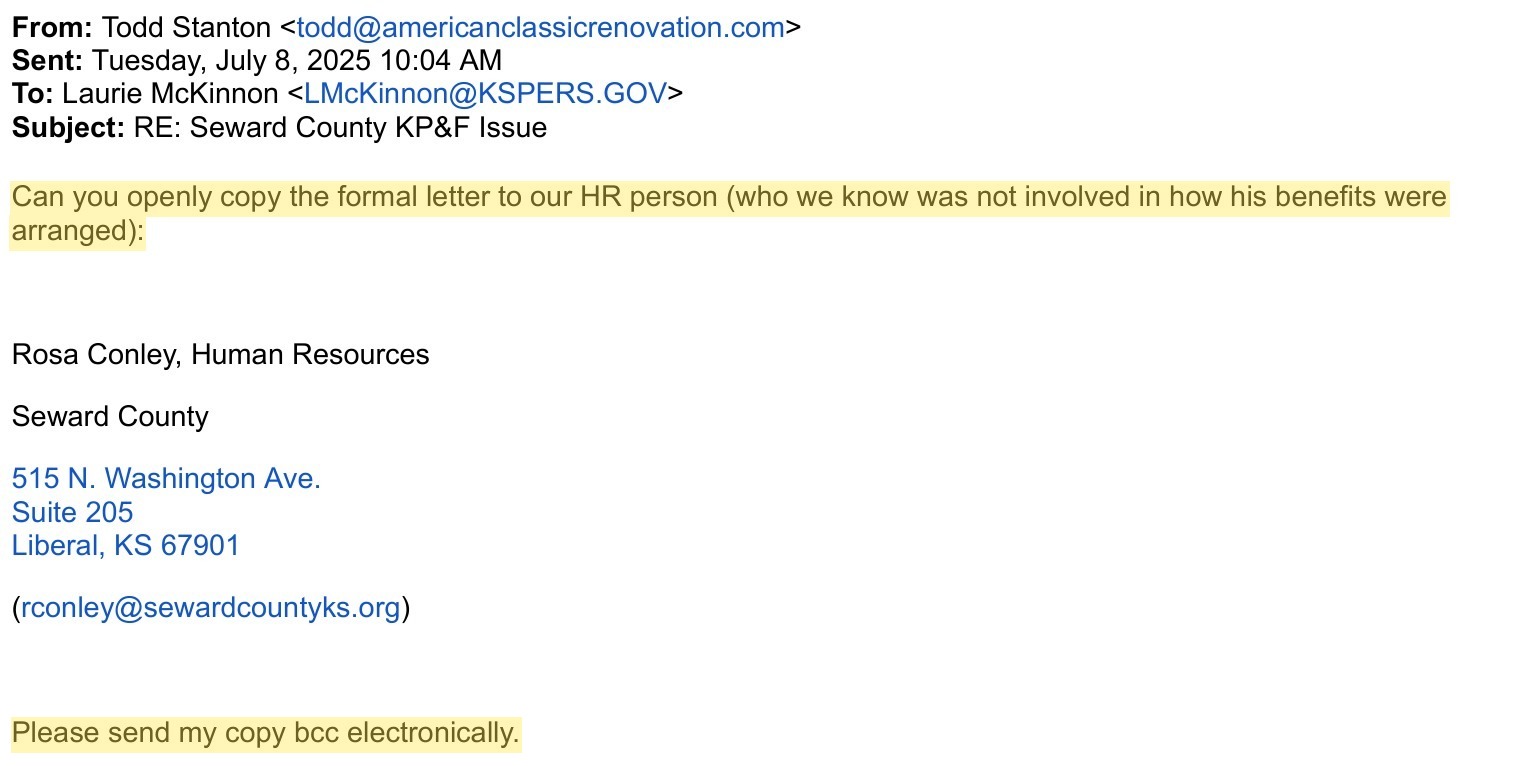
On July 8, 2025 he told the agency to copy the formal letter openly to a junior employee in Human Resources — “who we know was not involved in how his benefits were arranged” — and then: “Please send my copy bcc electronically.”
When Human Resources telephoned KPERS to ask who had raised the question, they were told only that “an employee of Seward County called and asked to remain anonymous.” Seward County had to ring Topeka to find out who had started this, and Topeka would not say.
No one is being recalled for asking questions about county spending. That is the job, and every department was under scrutiny that year. The question is not whether a commissioner may ask. It is what this one did with the asking: he went around every part of his own county government, to a state agency, from an account his county could not see, about one man’s pension.
He was not charged with anything, and we are not suggesting he should have been. The question a voter has to answer is a different one.