In June 2025, Commissioner Todd Stanton contacted the Kansas Public Employees Retirement System about the retirement of Greg Standard, who had worked for Seward County for 37 years. He did it from a personal business email account. He did not tell the County Administrator — and told the state agency he was deliberately not telling her. Within weeks, Mr. Standard’s first retirement check was cut by more than 25 percent. It took the Administrator, human resources, payroll, the Sheriff, a state representative and three senior KPERS officials to put it back.
Commissioner Stanton gave his own account of all this in a guest column on August 27, 2026. Several of the questions below are ones he has now answered in print — and those answers are quoted here beside the emails he wrote at the time. Our point-by-point response to the column is on The Record, and his column itself is here: liberalfirst.com.
Why did he ask to be blind-copied?
On July 8, 2025, Commissioner Stanton told KPERS how to distribute the formal determination letter. He asked them to copy it openly to the County’s HR office — and to hide his own copy.
“Can you openly copy the formal letter to our HR person… Please send my copy bcc electronically.” Todd Stanton to KPERS, July 8, 2025
If this was ordinary county business, why did his name need to be kept off the letter that went to his own county’s HR department?
Why use a private email account?
Every message in the KPERS correspondence came from a personal business email account rather than a county account — and each one was signed “Todd Stanton, Seward County Commissioner District 1.”
He has a county email account, and he uses it. On October 14, 2025 he used it to tell the County Administrator that her statements to the Board had “been shared with counsel for action.” County business done on the county system is a record the public can ask to see. None of the KPERS correspondence was.
If you are proud of the work and doing it in your official capacity, why not do it on the county’s system, where the public can see it and the county keeps a record of it?
Why was the County Administrator deliberately kept out?
Asked by KPERS whether Mr. Standard might already know about the inquiry, Commissioner Stanton listed who was in the loop — HR, payroll, the Sheriff, the Fire Chief — and explained one deliberate omission.
“County Admin was not informed because of concerns about how the benefits occurred in the first place.” Todd Stanton to KPERS, June 25, 2025
Two weeks later, when KPERS asked who should receive the determination letter, he named an HR employee instead — and gave his reason for choosing her: she was “who we know was not involved in how his benefits were arranged.” He vouched for her. He did not vouch for the Administrator.
The one official with access to the complete personnel records — the records that eventually corrected the error — was the one person left out. Why?
How many different ways can one question be answered?
In his first email to KPERS, Commissioner Stanton said he already held payroll data on every county employee enrolled in KP&F.
“I have records of all KP&F employees with figures from payroll for 2022 thru last month… If you need mine, I can send that to you.” Todd Stanton to KPERS, June 12, 2025
Since then he has been asked four times where that came from, and has given four different answers.
“payroll (we have one payroll clerk who provided the data for recent years)” To KPERS, June 25, 2025 — a county employee gave it to him
“I came to learn of county funds being errantly paid at the KP&F rates… while reviewing county budget items during our budgeting process.” To KPERS, July 28, 2025 — he found it himself. No employee appears anywhere in this answer.
The July 28 version is the one he gave knowing it would be repeated in Mr. Standard’s appeal. The next day, July 29, the County Administrator asked him the same question directly, in front of the Commission Chairman and the Sheriff. He refused to answer — people come to him in confidence, he said, and he would not break that confidence. He had already given the answer to a state agency in Topeka thirty-four days earlier. A year later, in his newspaper column, the county employee is back.
If the information was innocently come by, why has the answer changed every time he is asked — and why was the one audience he would not give it to his own County Administrator?
Why did his own county have to call Topeka to find out who started this?
The KPERS letter arrived at the County while the Administrator was on vacation. It said Seward County had reached out to ask whether the Emergency Management Director position was eligible for KP&F. Nobody in Administration or Human Resources had made that call. An HR Generalist telephoned KPERS to find out who had. She was told only that an employee of Seward County had called and asked to remain anonymous.
In his column, Commissioner Stanton gives a different account of how his name came to be left out — he writes that KPERS asked him whether there was any reason to leave his name out of things. The written record shows him giving the instructions: the private account, the Administrator deliberately not informed, the letter redirected to an HR employee, and his own copy blind-copied.
Four separate steps, and each one had the same effect — Seward County could not see that its own commissioner was the one doing this. Which of the four did KPERS ask him to take?
Did the Sheriff and the Fire Chief actually say that?
Commissioner Stanton told a state agency that two county officials shared his conclusion.
“It is the opinion of our rural fire chief and county sheriff that neither is eligible for KP&F.” Todd Stanton to KPERS, June 12, 2025
At the July 29 meeting the Fire Chief said Commissioner Stanton had approached him with questions about Mr. Standard’s retirement. Being asked is not the same as giving the opinion he was credited with to a state agency. Neither man has said publicly that he gave it, and neither has been asked on the record.
Did those two officials give the opinion a commissioner attributed to them in writing — and if not, what was a state agency relying on?
Was a criminal investigation waiting on his signal?
Twice, Commissioner Stanton described a Sheriff’s investigation to KPERS as something that would begin when he said so.
“Sheriff Gene Ward will commence an investigation as to how this occurred (and pass off to KBI if he feels that is best).” Todd Stanton to KPERS, June 19, 2025
“I don’t believe the Sheriff would commence investigation on how this happened until I gave him word everything had been settled at your end.” Todd Stanton to KPERS, July 7, 2025
These are Commissioner Stanton’s characterizations of what the Sheriff would do. The Sheriff has not confirmed them, and nothing on this page should be read as saying that he did.
Since when does a single county commissioner start and stop a criminal investigation — and if he does not, why tell a state agency that he does?
Why did KPERS only get one of the three job descriptions?
Greg Standard had three positions on file with the County: Emergency Management Director, Advanced Emergency Medical Technician, and Fire Deputy Chief. The AEMT and Fire descriptions are the ones that describe emergency response — riding the ambulance, answering alarms, commanding fire scenes. Commissioner Stanton sent KPERS one of the three: the Emergency Management Director description. KPERS ruled on it because, in their General Counsel’s words, it showed “few actual ‘on-call,’ EMS-related activities.”
His column says the determination was made “based solely upon records KPERS had.” The only position description KPERS had was the one he sent. Its own General Counsel says so, writing to the County Administrator five weeks after the decision:
“When I received the information from Mr. Stanton, along with the position description you said you’d never seen before, it was my job, then, to review the position.” KPERS General Counsel to the County Administrator, August 12, 2025
The document thirty-seven years of service was decided on was one the County Administrator had never seen. KPERS did not receive the other two descriptions until she sent all three that same afternoon.
At the Commission meeting of August 17, 2026 he answered this a different way:
“Seward County itself sends pension contribution records to KPERS. Why would records already had by KPERS be sent to KPERS? They have these records.” Commissioner Stanton, Seward County Commission, August 17, 2026
KPERS did already hold the County’s pension contribution records. It did not hold the position description, and the position description is what the determination turned on. He attached it to his first email himself: “I am attaching the County job description for our Emergency Management Director.” His August 17 remarks are on the County’s video: sewardcountyks.new.swagit.com/videos/396423.
Why did a commissioner acting alone get to choose which document the state saw, when the County’s records office held all three and produced them the moment KPERS finally asked?
Why pass along something you admit you haven’t verified?
In the same June 12 email, Commissioner Stanton relayed an allegation about Mr. Standard to the agency that was about to decide his pension.
“I’m told but have not verified this has been coordinated with a workman’s comp claim for carpal tunnel syndrome.” Todd Stanton to KPERS, June 12, 2025
Why tell a state agency something about a 37-year employee that you acknowledge you have not checked?
Why did a gun store come into it?
In his column, Commissioner Stanton explains that he mentioned to KPERS that one of the two subjects owned a gun store, and that KPERS then left his name out.
The gun store is Greg Standard’s. So the man the safety implication was about is the 37-year first responder whose pension was being contested — a volunteer firefighter, Advanced EMT, hazmat technician and storm tracker who spent his career answering other people’s emergencies.
The words “gun,” “firearm” and “weapon” do not appear anywhere in the KPERS correspondence — not once, across all five email threads. Nothing in KPERS’s files, the County Administrator’s notes or the Sheriff’s account suggests anyone treated Mr. Standard as a danger to anybody. The only place a gun store appears in this entire record is Commissioner Stanton’s own column, written a year later.
Why does a man’s lawful business belong in a conversation about his pension — and what was a state agency supposed to understand by it?
Who was next?
Mr. Standard was not the only name. We are not publishing the second employee’s name. He was never told at the time that his retirement classification was being questioned, and he is entitled to the privacy Mr. Standard was not given.
“Once the Greg Standard issue is resolved, we need to look at [a second employee] who is also being provided KP&F though he does not meet the criteria for this.” Todd Stanton to KPERS, July 8, 2025
Mr. Standard’s full twenty years of KP&F service were restored — the same figures KPERS’s own records showed before Commissioner Stanton ever contacted them. The second employee kept his benefits as well. Commissioner Stanton was wrong about both men, and both of them ended up with exactly what they had before he started.
We asked about the second outcome without naming the man, and we are reporting it the same way.
This was not one question about one man’s paperwork — it was a plan to work down a list. Any of five commissioners, the County Administrator or Human Resources could have answered it in an afternoon, and the answer would have been the same one everybody arrived at months later. Instead two men’s retirements were put in doubt and a state agency was pulled into a county matter. Why not simply ask?
Which account of the retirement paperwork is the true one?
On June 25, 2025 he told KPERS that Mr. Standard had just announced his retirement and had begun the paperwork the day before.
“Greg Standard has unexpectedly announced his intention to retire effective June 30 of this year. I believe he started the paperwork on that late yesterday.” Todd Stanton to KPERS, June 25, 2025, 7:18 AM
Thirteen days later, in the same email thread, the sequence is reversed — and he says he only learned of it on “last Thursday,” July 3. That is nine days after he reported it himself.
“I found out last Thursday that Mr. Standard oddly filed much of his own retirement paperwork about three weeks before he told admin he was retiring.” Todd Stanton to KPERS, July 8, 2025, 10:04 AM
Both statements are in the same thread, to the same reader, thirteen days apart. They cannot both be true. And there is nothing odd about the underlying fact in either version: county employees commonly file their own retirement paperwork, and Administration assists when asked.
Which is it — and why does a routine piece of paperwork need to be described as odd at all?
Does he really have no idea how it turned out?
His column says he has no idea what came of KPERS’s review or of Mr. Standard’s appeal. Three days before the determination was issued, he was asking where the money would go.
“At what point in the process would excess contributions come back to Seward County and who would be notified regarding that?” Todd Stanton to KPERS, July 7, 2025
KP&F costs the County more than regular KPERS, so moving Mr. Standard out of it meant the County had overpaid and a refund was owed. KPERS held that refund internally rather than sending it — in their words, putting both the employee and employer contributions “to the side for a little while” in case the appeal succeeded. It did succeed. The refund never came.
Commissioner Stanton presents himself as a commissioner watching the County’s money. He asked when that money was coming. A man watching for it would have noticed that it never arrived.
If he had no idea how it ended, why did he ask where the money would land — and how did he not notice it never landed?
Why not simply have the Board ask KPERS?
In his column, Commissioner Stanton dismisses the account of what he did as a “cloak and dagger sounding statement.” Here is what the plain alternative looked like, and it was available the whole time.
Seward County is the employer. Kansas law places the powers of a county in the Board of County Commissioners acting together, not in any one commissioner (K.S.A. 19-212). The Board meets in public, can go into executive session for a personnel matter, and can write to KPERS over its own name. Any commissioner with a question about how an employee is classified could have asked for that in one motion. Four other commissioners sat on that Board without knowing what was being done in the County’s name.
We know the open route works, because it is the one that ended this. Half an hour after the County Administrator finally got KPERS on the telephone, its General Counsel stopped everything:
“Okay, everyone stop what they’re doing… I just spoke with April and it appears something is going on here.” KPERS General Counsel, internal email, July 28, 2025, 4:10 PM
Two weeks later KPERS asked the County for Mr. Standard’s position descriptions. All three came back the same afternoon. Its General Counsel put her own mistake in one sentence: “My error was not contacting you, specifically, to make sure KPERS was moving in the right direction.”
At the July 29, 2025 meeting Commissioner Stanton said the Kansas County Commissioners Deskbook gave him authority to act alone. The Deskbook says the opposite.
“When the Board is not in session, the individual members have no more legal authority than do private citizens.” Kansas County Commissioners Deskbook, §1.3.1
Its single example of what one commissioner may not do alone is examine an employee’s personnel records — which is, almost exactly, what this case is about. Its advice to commissioners in counties with an administrator is three words: “Don’t bypass the system.” Every page of the 308-page 2025 edition has been searched, and it contains no provision allowing a commissioner to act alone because he believes a crime has occurred. The Commission Chairman told him at that meeting that he had no authority to act alone and should have brought it to the full Commission or asked for an executive session. Commissioner Stanton said he would not apologize and would handle it the same way again.
Five commissioners, a meeting held in public, an executive session available for personnel matters, and a county administrator holding the complete file. One question from the Board would have answered it, and when somebody finally did ask, it was answered in weeks. Why the private email account instead?
Why ask that the County Administrator be charged with a crime?
In July 2025, Commissioner Stanton asked Sheriff Gene Ward to file criminal charges against County Administrator April Warden for misappropriation of county funds. The Sheriff told him he could not simply file charges. The KPERS attorney the Sheriff then consulted said there was nothing criminal — it was the kind of classification error that happens when someone is unsure whether an employee belongs in KPERS or KP&F.
Ms. Warden asked him about it to his face on July 29, 2025, at a meeting in the County Administration Building. Commission Chairman Scott Carr and Brock Theiner of the County were in the room. He denied it — and sent for the Sheriff himself.
“those words did not come out of my mouth. I think you better call Sheriff Ward and get him over here now.” Commissioner Stanton, July 29, 2025, as recorded in the County Administrator’s contemporaneous notes
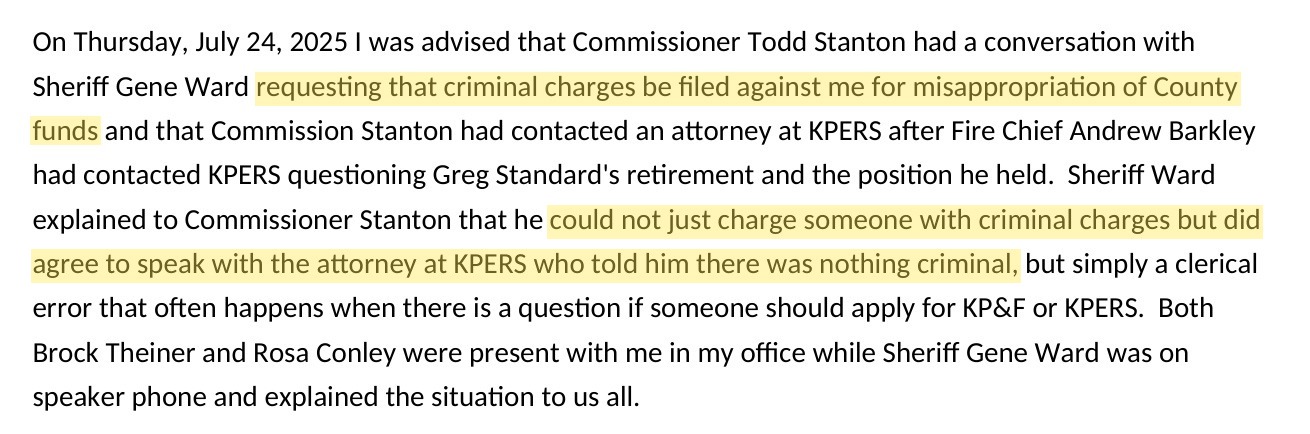
Sheriff Ward came. Per those same notes, he verified that Commissioner Stanton had asked him to file criminal charges against the County Administrator. And when Ms. Warden said the Sheriff was free to go, Commissioner Stanton asked him to stay — as a witness for him.
Those notes are one person’s written record. The three county officials who were in that room are not. Ms. Warden, Mr. Carr and Mr. Theiner have each been asked about it since, and all three say the same thing: Commissioner Stanton asked for criminal charges to be brought against the County Administrator.
A year later he denied it again — this time in public, from his seat at the Commission table. On July 20, 2026, Chairman Steven Helm raised it during a Commission meeting. Commissioner Stanton cut him off.
Chairman Helm: “…you’ve tried pressing criminal charges against April…”
Commissioner Stanton: “No, that was a false statement.”
Commissioner Stanton: “And I’m gonna stop you right there.”
Commissioner Stanton: “A false statement.”
Chairman Helm: “You tried getting criminal charges against her.”Seward County Commission, July 20, 2026 · from the County’s transcript of its own video recording
You do not have to take our word for this one. It is on the County’s video of the meeting, two hours, five minutes and forty-five seconds in: sewardcountyks.new.swagit.com/videos/393954.
Four weeks after that, at the Commission meeting of August 17, 2026, he gave a fuller account. This one is not a denial.
“At no time did I request the Sheriff go and arrest April Warden. At the time I was talking with the Sheriff, neither of us knew who might be responsible. I most certainly did say something along the lines of whoever was responsible should be prosecuted if this was in fact appropriate.” Commissioner Stanton, Seward County Commission, August 17, 2026
He now agrees he told the Sheriff that somebody should be prosecuted. What he disputes is the name. But “neither of us knew who might be responsible” is difficult to place beside what he had written to KPERS seven weeks before that conversation — that the County Administrator was deliberately not being told “because of concerns about how the benefits occurred in the first place.” He had a concern precise enough to keep one named official out of it.
So the account has moved three times. The words did not come out of his mouth. Then it was a false statement. Then he most certainly did say it — only not about her. That third statement is on the County’s video of the August 17 meeting: sewardcountyks.new.swagit.com/videos/396423. The County notes that its written transcripts are produced by voice-to-text and are not the official minutes — so watch the recordings and judge for yourself.
He sent for the Sheriff himself, asked him to stay as his own witness, and the Sheriff confirmed the very thing he was denying. Three county officials who were in the room say the same. On what evidence does a commissioner ask law enforcement to charge a county employee with a crime — and which of his three accounts of it is the true one?
What did this cost, and who pays for it?
Acting on the information Commissioner Stanton supplied, KPERS moved all 20 years of Mr. Standard’s KP&F service into regular KPERS. KP&F pays a 2.5% retirement multiplier; regular KPERS pays 1.85%. KPERS calculated the difference the same afternoon, with and without the KP&F service. His first retirement payment was cut by more than 25 percent — more than a quarter of the pension he had spent a career earning. The dollar amounts are Mr. Standard’s private business and we do not publish them.
Undoing it took the County Administrator, HR, payroll, the Sheriff, the Fire Chief, a state representative, and KPERS’s general counsel, chief benefits officer and executive director. His full 20 years were ultimately restored.
Every hour of that was paid for by Seward County taxpayers and Kansas taxpayers. What did the county get for it?